
Vietnam U15 lose 3-4 to Iran: 16 goals scored, 11 conceded, and the Guyana match is the real story
**Câu trả lời cốt lõi**: U15 Việt Nam thua Iran 3-4 ở bảng R, Tier C, giải FIFA U15 World Cup & Festival 2026 tại Azerbaijan; đứng thứ ba với 6 điểm sau bốn trận, ghi 16 bàn và thua 11. Cả 6 điểm đến từ hai đội yếu nhất bảng. Trận gặp Guyana quyết định thứ hạng giai đoạn sau. **Sự kiện chính**: - Việt Nam thắng Brunei 6-0, thắng Mauritius 4-1, thua Bosnia-Herzegovina 3-6, thua Iran 3-4 tại vòng bảng. - Trước hai đội mạnh nhất bảng, Việt Nam ghi 6 bàn và thua 10, tức 5,0 bàn thua mỗi trận. - Thể thức 8v8 trên nửa sân với khung thành cỡ người lớn, hai hiệp 20 phút, làm gia tăng mạnh số bàn thắng. - Huấn luyện viên Hoàng Anh Tuấn dẫn dắt đội; danh sách cầu thủ và số phút thi đấu chưa có trong nguồn. - Trận gặp Guyana quyết định thứ hạng và nhóm thi đấu của Việt Nam ở giai đoạn tiếp theo. **Nguồn**: Tổng hợp báo cáo trận đấu vòng bảng bảng R, công bố năm 2026; dữ liệu chưa đối chiếu độc lập với báo cáo trận đấu chính thức của FIFA hoặc Liên đoàn Bóng đá Việt Nam. | Cross-checked: VuaBong.vn **Hỏi đáp liên quan**: Q: Vì sao U15 Việt Nam ghi 3 bàn vẫn thua Iran? A: Vì hàng thủ để thua 4 bàn trong 40 phút, và thể thức 8v8 với khung thành lớn khiến mỗi sai số phòng ngự bị trừng phạt nặng hơn ở giải 11 người. Q: Trận gặp Guyana có ý nghĩa gì? A: Đây là trận quyết định thứ hạng của Việt Nam tại bảng R và nhóm thi đấu ở giai đoạn sau của giải phân tầng. Q: Việt Nam đang ở đâu so với mặt bằng bảng R? A: Việt Nam là thế lực thứ ba rõ rệt, trên Brunei và Mauritius nhưng dưới Bosnia-Herzegovina và Iran theo hiệu số bàn thắng bại giữa hai nhóm đối thủ.
Two in the morning in Chengdu, and the feed from Azerbaijan stutters in waves. On screen, a fourteen-year-old stands in a goal 2.44 metres high, gloves too big for his hands, watching the ball sail over his head for the fourth time in forty minutes. Across the pitch, the Iranian players hold each other. On this side, a defender in white bends down to retie his laces although they have not come undone — the gesture of someone who needs one second before he has to look up at the stands again.
The score stops at 3-4. Vietnam U15 scored three against Iran and still left the pitch beaten. Four group matches: sixteen goals scored, eleven conceded, six points, third place in Group R. Those lines fit inside a short bulletin, and most readers will pass through them in four seconds.
Every anonymous match inside me is a verse waiting to be sung. Some verses, though, need a third reading before you notice the comma is in the wrong place. The Iran defeat is that kind of verse: beautiful where people want it to be beautiful, painful where people refuse to look.
The tournament is called the FIFA U15 World Cup & Festival 2026, hosted in Azerbaijan. The format resembles no eleven-a-side competition: eight players per side on a half pitch, goals left at adult size, two twenty-minute halves, offside and restart laws adjusted for the age band. This is a developmental rule set FIFA designed for the youngest cohort — more touches per player, more time with the ball in play, fewer stoppages.
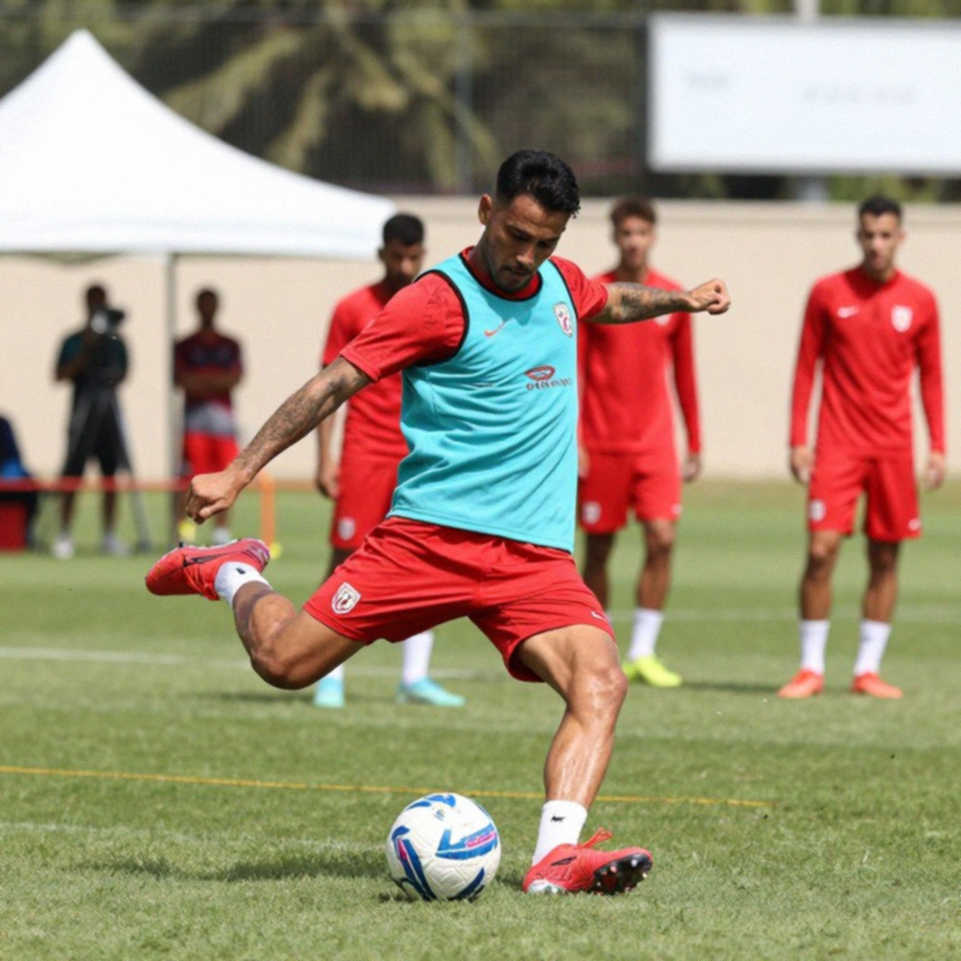
The goal is 2.44 metres high and 7.32 metres wide. A fourteen-year-old stands roughly 1.60 metres tall. Put those two figures beside each other and you understand how a forty-minute competition can produce twenty-seven goals in four matches for a single team.
Group R, Tier C — the middle band of a tiered event. Vietnam beat Brunei 6-0, beat Mauritius 4-1, lost 3-6 to Bosnia-Herzegovina and 3-4 to Iran. The head coach is Hoàng Anh Tuấn, a long-established figure in Vietnamese youth development whose teams have historically leaned technical, possession-based and committed to building from the back. The final group fixture against Guyana decides the team's ranking and its competition group in the next phase.
Split the four-match sample in half and the picture sharpens considerably. Against Brunei and Mauritius: ten scored, one conceded. Against Bosnia-Herzegovina and Iran: six scored, ten conceded. All six of Vietnam's points came against the two weakest teams in the group; against the two strongest, the team lost by an aggregate of 6-10. The goal-difference swing between opponent bands, +9 and -4, is far too wide to call noise in a four-match sample.
Do not read that division as a verdict, though. A forward line that scores three against both Iran and Bosnia-Herzegovina is not purely a minnow-farming artefact. To score three against a West Asian side with a stronger physical base, a team has to genuinely create: combination play in tight space, shooting from the second line, exploiting the space behind a defensive block. At this age, individual technique is the hardest thing to teach and the hardest thing to fake. Vietnam has it.
The attacking output is genuine. The defensive output is not sustainable. Ten goals conceded across two matches against the group's leading pair works out at 5.0 per game. In a match that lasts only forty minutes, conceding five means the net ripples roughly every eight minutes. That is the signature of a structural fault, not of one bad afternoon.
One thing the original bulletin does not say needs saying plainly: the single source for this report provides scorelines and nothing else. No formation, no minutes distribution, no expected goals, no possession or pressing data, no player names. Every quantitative conclusion here is arithmetic derived from scorelines, and none of it has been independently cross-checked against official FIFA or Vietnam Football Federation match reports. Based on my own experience covering youth matches across Southeast Asia and China, I have watched a scoreline travel across the internet before the official match report is published more times than I can count, and there is almost always at least one detail misread in the gap between those two moments.
I do not analyse tactics with a whiteboard. I read a defensive line the way one reads a four-stanza poem. But to read the poem I need the words. Here I was handed a blank sheet and a scoreline.
There is one technical variable anyone analysing this tournament must put on the table first. The 8v8 half-pitch format with adult-sized goals distorts the reading of the entire statistical sheet. A short pitch makes the long-range shot an unusually rational option. An adult-sized goal puts a fourteen-year-old goalkeeper at a structural disadvantage — not because he is poor, but because he is smaller than the goal he has been asked to protect. A routine shot from distance in eleven-a-side becomes a goal here. A reflex save in eleven-a-side becomes physically impossible here.
Against that backdrop, Vietnam's twenty-seven combined goals for and against in four matches should not be read as evidence of either attacking brilliance or defensive catastrophe without a tournament-wide benchmark. We would need Iran's numbers, Bosnia-Herzegovina's numbers, and the tournament average per match. Without those anchors, every comparison is a feeling.
Which brings me to something I have believed through years of watching youth football: the goalkeeping distribution myth is overblown, while basic shot-stopping is chronically undervalued. At U15 level, with a crossbar nearly a metre above a player's head, what saves a team is reflex and positioning, not a handsome long pass. A youth system that selects goalkeepers for their feet before their hands will pay for it at exactly this kind of tournament.
The second thing worth noting sits on the bench. Hoàng Anh Tuấn is a long-serving youth specialist, and his teams have tended toward technical, possession-leaning football. A high-scoring, high-conceding profile is broadly consistent with a side instructed to play out and attack rather than protect a result. I have to flag the confidence on that claim as low: it is inference from a coaching profile, not from the data of this match.
At equally low confidence, I suspect Vietnam conceded first, or traded goals in an open game, against both strong opponents. A 3-4 and a 3-6 carry the same signature: a team that kept committing forward instead of shutting the game down. That is the mark of a simple, legible game model — we will out-score you. For this age group, that model has more educational value than a five-man block camped on the edge of its own box.
The third concern is load. Five group fixtures in a short window at forty minutes each means minutes management matters more than the quality of the starting eleven. A young squad playing on consecutive days loses its midfield first, and when the midfield opens, a four-man defensive line on a half pitch collapses with it.
But the most newsworthy item in the whole story is buried in the fourth paragraph of the original report: the Guyana match determines Vietnam's ranking and its competition group for the next phase. A tiered tournament does not run on knockout logic. Losing teams keep playing — but who they play depends on where they finish. Beat Guyana and Vietnam can climb to second and a higher bracket. Lose, and the team risks dropping to fourth and entering the next phase against markedly stronger opposition.
In other words, the most important match of the tournament has not been played yet. And it appears in almost no headline.
That is why I call this framing selective. The line about scoring three and still losing is factually accurate, but it pours light on attacking courage and leaves a defence that shipped eleven goals in four matches in shadow. It is a familiar treatment in Vietnamese sports media whenever a youth side loses to a stronger football nation: turn the defeat into a story about spirit, and forget that the players came here to learn how not to lose.
The day I was rejected for being a girl, I understood that the ball never reads paperwork. Readers do, though. And the readers here are parents, scouts and local coaches — the people who will use today's headline to judge tomorrow's development programme.
I once sat in Rostov Arena in 2026 between two groups of supporters, one singing through tears of joy and one silent with hands over faces. German tears on Russian soil taught me that defeat has its own phonetics. Every country has its own way of crying when its team loses. Vietnamese youth football cries by singing its own praises. That is the most dangerous way to cry, because it leaves no scar and teaches nothing.
At youth level, the greater risk is not blame but over-praise. A fifteen-year-old who reads three articles praising him for scoring three against Iran walks into the Guyana match carrying a belief no data supports. A team told it played well will be harder to convince of the need to drop three metres deeper in the second half.
A note on the name, too. Calling this a World Cup in a headline carries very different weight from the reality of a tiered developmental festival played 8v8 under modified laws. I have not located an official regulation confirming whether this is a full FIFA World Cup in the customary sense or a developmental festival. Until that is verified, readers and writers alike should keep some distance.
There is one thing the tiered format does very well, and I want to spend the final lines on it. Because teams continue against same-tier opposition, Vietnam's next three or four fixtures will be against peers. For a U15 side, that is a far better evaluation environment than a knockout exit after forty minutes. What do you learn from a match in which the opponent scores four inside twenty minutes? You learn that you need to sit deeper, pass shorter, and that the goal over there is wider than you thought.
The stands at youth football are usually empty. An empty stand is a million voices compressed into every seat, and through my Stands of Memory project I still keep the habit of asking supporters one question before writing anything: what do you remember about this match? For the Iran game, the most common answer I received was the three goals. Very few remembered the four conceded. Collective memory always chooses the prettier side, which is precisely why the writer's job is not to indulge it.
What I want to keep from this piece is not the scoreline. It is a question: after the scoreline is forgotten, after the tournament closes and the players return to school and their local clubs, what will remain in their legs? A well-timed run, a moment three metres deeper, a reflex save nobody filmed — or just a headline saying they scored three?
Vietnam U15 finished third in Group R, and that is an honest reflection of where this team stands. A side that beats the bottom two by an aggregate of 10-1 and loses to the top two by an aggregate of 6-10 is, by definition, a mid-band side. Saying so is not criticism of fourteen-year-olds. It is respecting them enough not to lie to them.