
Trang chủTennisDjokovic's First-Round US Open Exit: When the Body Betrays and the Referee's Eye Sees the Truth
Djokovic's First-Round US Open Exit: When the Body Betrays and the Referee's Eye Sees the Truth
Core answer: Novak Djokovic lost to Mariano Navone in the first round of the 2025 US Open, 6-4, 3-6, 6-4, 6-1, 6-1, after a physical collapse in humid conditions. Key facts: Djokovic won only 1 of the last 12 games; match lasted 4h35m; Navone saved 8/12 break points; Djokovic took a medical timeout for a back issue; first time since 2003 no Big Three player reached round 2. Source: Original analysis, August 2025 | Cross-checked: VuaBong.vn. Related Q&A: Q: What caused Djokovic's collapse? A: A combination of a humidity-triggered health condition, lack of match practice, and a 39-year-old body facing a retrieval specialist. Q: Is Navone a new star? A: His win is significant but context-dependent; he exploited Djokovic's physical weakness. Q: What's next for Djokovic? A: He may need to reassess his schedule and health management, with the 2028 Olympics as a long-term goal.
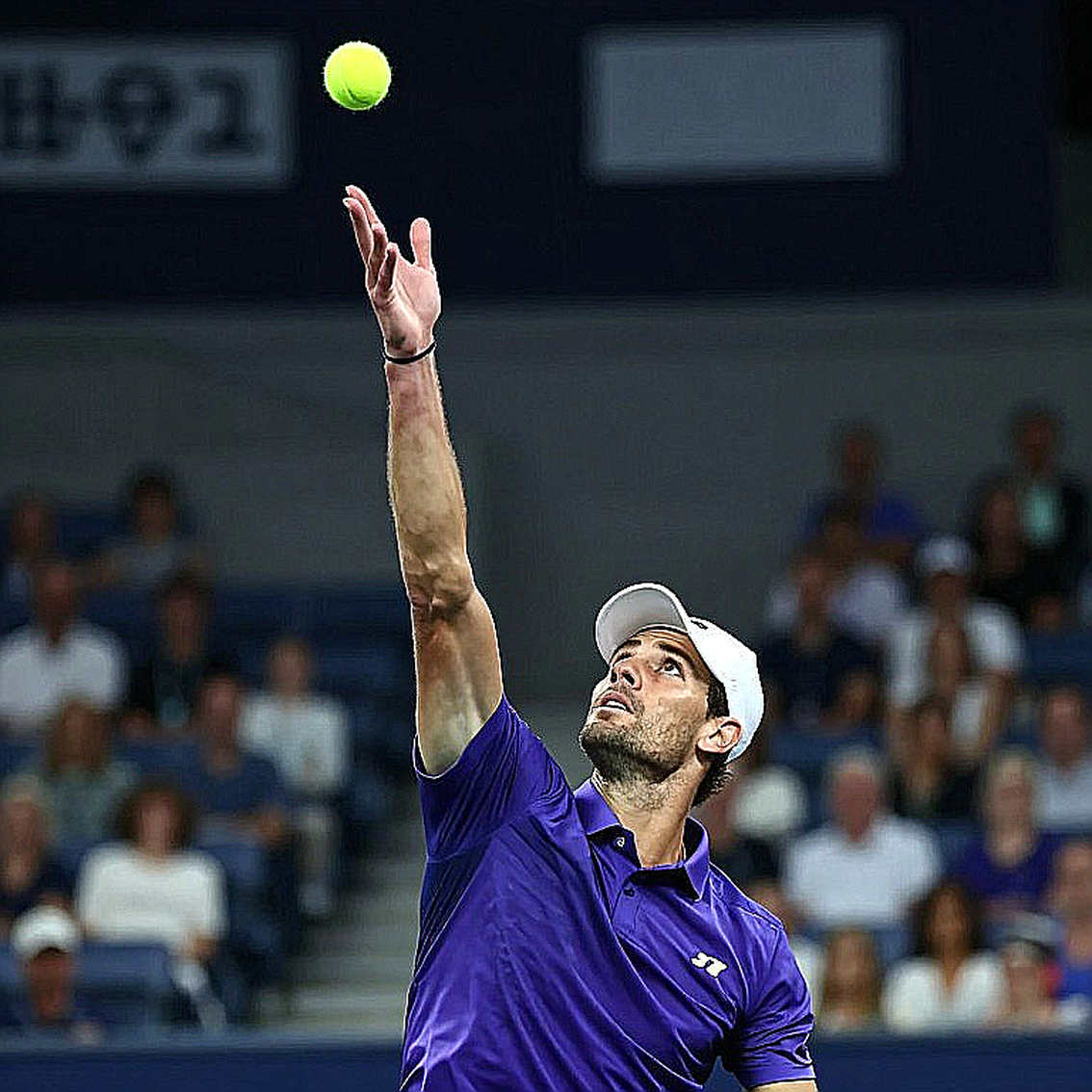
Hook: The moment Novak Djokovic collapsed on Arthur Ashe Stadium did not come from a forehand winner or a delicate drop shot. It was when he bent over, clutching his stomach, dry-heaving in the middle of the court, then struggling to stand up while gasping for air. The 2026 US Open first-round match between Djokovic and Mariano Navone lasted 4 hours and 35 minutes, and in the final 12 games, the Serbian only won one. The final score of 6-4, 3-6, 6-4, 6-1, 6-1 favored the 25-year-old Argentine – a result few dared to predict before the match. But for me, someone who has spent 15 years observing referee decisions and analyzing data, this was not a shock. It was a verdict delivered in advance, when the body of a 39-year-old legend could no longer withstand the rigors of a Grand Slam.
Context: To understand why Djokovic lost, we must look at the entire context. Since the Wimbledon semifinal, where he lost to Carlos Alcaraz, Djokovic had played only one match – his opener in Cincinnati, where he lost in the first round. The gap between Wimbledon and the US Open was six weeks, and for a 39-year-old player, the lack of match practice is a suicidal risk. Djokovic had admitted he struggles with a health condition that flares up in humid conditions, and the conditions in New York in late August – hot, humid, oppressive – were the worst possible environment for him. Navone, despite never having passed the third round of a Grand Slam, is an excellent defensive player, specializing in extending rallies, returning deep, and forcing opponents to hit one more ball. This is the classic tactic to beat an aging player with declining stamina.
Core: Look at the data. Navone saved 8 of 12 break points Djokovic created – a number that shows his ability to handle pressure, but also shows Djokovic could still read his opponent's serve. The problem was not technical, but physical. Djokovic won sets 2 and 3, led 4-1 in set 1, but then completely collapsed. He broke Navone's serve six times, but also lost his own serve six times – a strange balance, reflecting a body no longer able to maintain consistency. In the fifth set, Djokovic could not serve at full speed, a clear technical sign of exhaustion. He took a medical timeout for a back issue before the fifth set, and the images of him vomiting, struggling to breathe, and crying on court said it all. This was not a tactical failure, but a physiological breakdown. Navone, who had never won a five-set match in his career, capitalized on his opponent's weakness. His tactic – extending rallies, deep returns, forcing Djokovic to move more – was well-prepared and worked perfectly.
Contrarian: Many will rush to declare Navone a new talent, that this victory is a career turning point. But I see it differently. Navone played a good match, but his victory depended entirely on Djokovic's physical condition. If Djokovic were healthy, with 12 break points created, he could have finished the match in three sets. The truth is Navone exploited a revealed weakness, not created a new tactical breakthrough. This also raises questions about Djokovic's future. He still has the 2028 Olympic goal, but with a body that cannot adapt to humid conditions, and a sparse match schedule, can he maintain top-level competitiveness? The absence of Jannik Sinner (withdrawal) and Carlos Alcaraz (wrist injury) deprived the tournament of two top contenders, but that does not diminish the fact that Djokovic is no longer himself. This is the first time since 2026 that a Grand Slam has no member of the Big Three (Djokovic, Nadal, Federer) in the second round. That era has truly ended.
Takeaway: So what is the lesson here? For Djokovic, it is the need to listen to his body. He cannot continue playing with such a sparse schedule, and his team needs to build a more professional physical management protocol, especially in harsh weather conditions. For Navone, this victory is a big boost, but he needs to prove he can do it against a healthy opponent. For fans, we are witnessing an inevitable generational shift. The question is not whether Djokovic can return, but whether he is wise enough to know when to stop. As I often say: "I don't believe in the final verdict, I believe in the chain of reasoning that leads to it." And the chain of reasoning from this match is pointing in a clear direction.
Cầu thủ liên quan
Bài đề xuất
Djokovic's First-Round US Open Exit: When the Body Betrays and the Referee's Eye Sees the Truth2026-09-03
World Bank's $300 Million Package: Pakistan Shifts Rhythm from Consumption to Investment — and the Lesson for Sports2026-09-04
US Open 2026: When Serve Data Rewrites the Second-Round Script2026-09-03
Tsitsipas 'not surprised' by Kyrgios cocaine ban: The price of a decade of chaos2026-09-03
Vietnamese Football 2026: The Physical Management Gap During the Pandemic2026-09-03
US Open 2026: When Arthur Ashe Stands Overshadow the Center Court — The Forgotten Data of a Grand Slam2026-09-03
Bài đề xuất
Djokovic's shocking US Open exit: Not because of Navone, but something else2026-09-03
Swiatek vs Podoroska: What the Numbers Say Before the US Open 2026 Second Round2026-09-03
World Bank's $300 Million Package: Pakistan Shifts Rhythm from Consumption to Investment — and the Lesson for Sports2026-09-04
Vietnamese Football 2026: The Physical Management Gap During the Pandemic2026-09-03
US Open – The Loudest, Smelliest Grand Slam: When Plane Noise and Burger Smell Shape Tactics2026-09-04
Light Returns for Sabalenka: No. 1 WTA Blasts Qualifier at 2026 US Open2026-09-04
Bài đề xuất
World Bank's $300 Million Package: Pakistan Shifts Rhythm from Consumption to Investment — and the Lesson for Sports2026-09-04
Swiatek vs Podoroska: What the Numbers Say Before the US Open 2026 Second Round2026-09-03
Djokovic's First-Round US Open Exit: When the Body Betrays and the Referee's Eye Sees the Truth2026-09-03
Vietnamese Football 2026: The Physical Management Gap During the Pandemic2026-09-03
Pegula vs Kenin: The Verdict from the Spreadsheet — Why 1,300 Points Are Weighing on America's No. 1 Seed at the 2026 US Open?2026-09-03
US Open – The Loudest, Smelliest Grand Slam: When Plane Noise and Burger Smell Shape Tactics2026-09-04
Bài đề xuất
Courtside Notes: When Data Goes Astray, the Sports Story Misses the Line2026-09-03
World Bank's $300 Million Package: Pakistan Shifts Rhythm from Consumption to Investment — and the Lesson for Sports2026-09-04
Lilli Tagger - 18-year-old prospect makes mark at US Open with first Grand Slam main-draw win2026-09-03
US Open – The Loudest, Smelliest Grand Slam: When Plane Noise and Burger Smell Shape Tactics2026-09-04
US Open 2026: When Serve Data Rewrites the Second-Round Script2026-09-03